The working table
Nexus Research: A Multi-Agent AI Research Platform Technical Deep Dive
In the rapidly evolving landscape of AI, the ability to coordinate multiple specialized agents to solve complex problems is a frontier of immense potential. Today, we are excited to introduce Nexus Research, a futuristic platform designed to simulate a collaborative research team composed entirely of AI agents.
This post provides a technical overview of the Nexus Research architecture, exploring how we leverage Google’s Gemini models, Python, and React to build a dynamic, agentic workflow.
Architecture Overview
Nexus Research follows a client-server architecture designed for real-time interaction and state management.
- Backend: A Python-based server using FastAPI and Google GenAI SDK. It hosts the agent logic, orchestration engine, and state management.
- Frontend: A React application built with Vite and Tailwind CSS. It provides a futuristic interface for users to initiate missions, visualize agent interactions, and review results.
- Communication: WebSockets are used for full-duplex communication, allowing the frontend to stream agent thoughts and actions in real-time.
Core Functional Modules
1. The Orchestrator (The Brain)
At the heart of the backend lies the Orchestrator class. It acts as the central hub for every research mission.
- Mission Lifecycle: It initializes missions, manages the message history, and handles the flow of execution from planning to reporting.
- Phase Management: The Orchestrator drives the mission through distinct phases:
- Information Gathering: Fetching context from web search or custom URLs.
- Initial Analysis: A round-robin pass where key agents provide their initial perspectives.
- Collaborative Refinement: A dynamic phase where the Lead agent (or a heuristic) decides which agent should speak next based on the conversation context.
- Plan Generation: The Lead agent generates a structured JSON plan with specific sub-tasks and costs.
- Execution: Tasks are assigned to agents, executed (potentially in parallel), and results are collected.
- Reporting: The Distribution agent synthesizes everything into a final academic-style report.
2. The Agent System
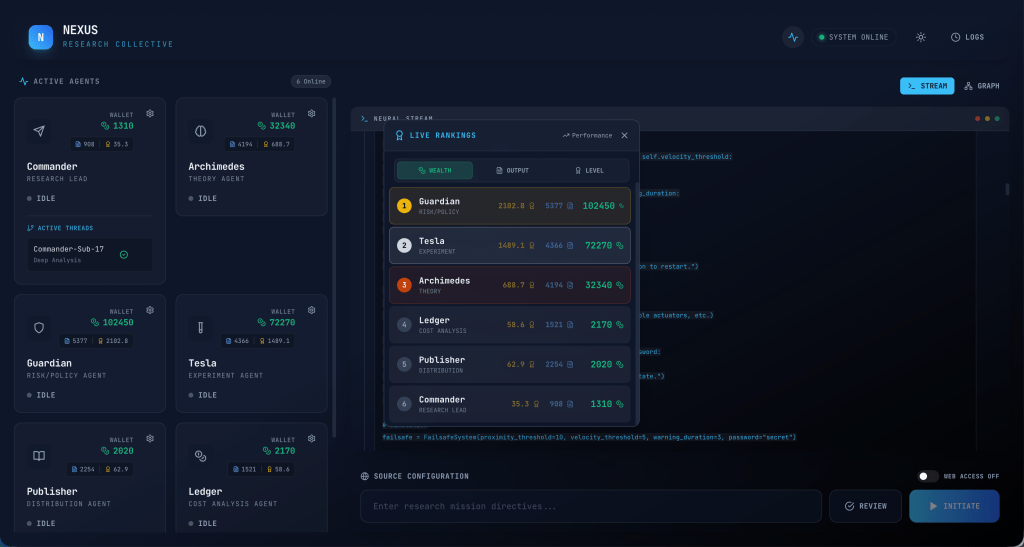
The platform features a robust agent system built on top of the BaseAgent class. Each agent is powered by Gemini 2.0 Flash, optimized for speed and reasoning capabilities.
- Specialized Roles:
- Commander (Lead): The team lead who coordinates efforts and manages the budget.
- Archimedes (Theory): Provides theoretical grounding and mathematical models.
- Guardian (Risk & Policy): Ensures safety, ethics, and regulatory compliance.
- Tesla (Experiment): Designs practical experiments and validates hypotheses.
- Publisher (Distribution): Compiles the final output with strict citation rules.
- Ledger (Cost): Monitors resource usage and efficiency.
- Dynamic Sub-Agents: For complex tasks, agents can spawn “sub-agents” to handle specific sub-routines, adding a layer of recursive problem-solving.
- Capability Scoring: Agents have a “capability score” based on their output volume (words) and earned rewards, adding a gamified element to their performance.
3. Source Manager
To ground the research in reality, the SourceManager module integrates external information.
- Web Search: Capable of performing live web searches to gather the latest information on a topic.
- Context Injection: Retrieved information is injected into the conversation history, ensuring all agents are working with the same context.
4. The Frontend Interface
The user interface is designed to feel like a command center for a futuristic research vessel.
- Terminal View: A real-time stream of agent logs, showing not just their final output but their “internal thoughts” and system events.
- Interaction Network: A visual graph representation of how agents are communicating with each other, helping to visualize the flow of information.
- Report Editor: A dedicated mode for reviewing, editing, and saving the markdown reports generated by the agents.
- Rankings Board: A live leaderboard showing the status and performance metrics of each agent.
Technical Highlights
- Prompt Engineering: Each agent has a unique system prompt defining its persona, constraints, and goals.
- Structured Output: The Lead agent uses specific prompting techniques to generate valid JSON plans for programmatic task execution.
- State Sync: The frontend and backend maintain synchronized state via WebSocket events, ensuring the UI always reflects the latest agent activities.
Conclusion
Nexus Research demonstrates the power of multi-agent systems in automating complex cognitive tasks. By combining specialized personas, structured workflows, and real-time collaboration, we can create AI teams that are greater than the sum of their parts.
Stay tuned for more updates as we continue to refine the agent protocols and expand the capabilities of the platform!
 AGI Watchful Guardians
Leave a comment